It is the Duty of a welding inspector to ensure that all operations concerning welding are carried out in strict according with written, or agreed practices, or specifications.
This will include monitoring or checking a number of operation including:
Before Welding
Safety:
Ensure that all operations are carried out in complete complience with local company, or National safety legislation(i.e. permits to work are in place).
Documentation
Specification (Year and revision)
Drawing (Correct revisions)
Welding procedure specification and welder approvals
Calibration certification (Welding equipment/ancillaries and all inspection instrument)
Material and cionsumable certification
Welding Process and Ancillaries
Welding equipment and all related ancillaries (Cable, regulator, ovens, quivers, etc)
Incoming Consumable
All pipe/plate and welding consumable for size, type and condition.
Marking out preparation and set up:
Correct nethod of cutting weld prepararions (pre heat for thermal cutting if applicable)
Correct preparation (Relevant bevel angles, root face, root gabe, root radius, land, etc)
Correct pre-welding distortion control (Tacking, bridging, jigs, line up clamps, etc)
Correct pre heat applied prior to tack welding
All tack to be monitored and inspected.
During Welding
Pre-heat values (Heating methode, location and control)
In-process distortion control (Squence or balanced welding)
Consumable control (Specification, size, condition, and any special treatment)
Process type and all related variable parameters (Voltage, amperege, travel speed)
Purging gases (Type, pressure/flow and control methode)
Wedling condition for root run/hot pass and all subsequent run, and inter0run ceaning)
Minimum, or maximum inter-pass temperature (Temperature and controling methode)
Complience with all other variables sated on the approved welding procedure
After Welding
Visual inspection of the welded joint (including dimensional aspects)
NDT requirements (Methode and qualification of operator, and excecution)
Identify repairs from assesment of visual or and NDT reports (Refer to repair below)
Post weld heat treatment (PWHT) (Heating method and temperature recording system)
Re-inspect with visual/NDT after PWHT (if applicable)
Hydrostatic test procedures (For pipelines or pressure vessels)
Repairs
Excavation procedure (Approval and execution)
Approval of NDT procedures (For assessment of complete defect removal)
Repair procedure (Approval or re-welding procedures and welder approval)
Execution of approved re-welding procedure (Complience with repair procedure)
Re-inspect the repair area with visual inspection and approved NDT methode.
Submission of inspection reports, and all related documents to the Q/C departement.
» Read More...
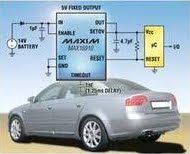 Rugged automotive linear regulator uses only 20µA of quiescent current.
Maxim's new linear regulator consumes only 20µA (typ) of IQ to conserve battery life, and includes a reset output with adjustable delay so no external reset IC is needed.
The MAX16910, an ultra-low quiescent current, high-voltage linear regulator with a reset output. This 200mA linear regulator consumes only 20µA (typ) of quiescent current to conserve battery life in always-on automotive applications. Designed for automotive environments using Maxim's robust BiCMOS process, the MAX16910 is capable of operating from a wide, 3.5V to 30V input-voltage range to withstand cold-crank and double-battery conditions; it can also operate during load-dump conditions up to 45V. Additionally, the integrated open-drain reset output with adjustable delay eliminates the need for an external reset IC. Thus, the MAX16910 is ideal for always-on automotive applications in which small solution size and power efficiency are critical.
The MAX16910 has three pin-selectable output-voltage configurations: fixed output voltages of 3.3V or 5V, or an externally adjustable output-voltage range from 1.5V to 11V. The reset output has a delay that is adjustable through a small external capacitor. Additional protection features include a short-circuit current limit and thermal shutdown.
The MAX16910 is fully specified over the -40°C to +125°C automotive temperature range. It is AEC-Q100 automotive qualified and is available in thermally enhanced 8-pin TDFN and SO packages.
» Read More...
 The E60, like the E80 launched earlier this year, features a completely new design that increases the comfort of the operator and the durability of the machine, while decreasing the frequency needed for some preventive maintenance tasks. Everything about the new excavator has been created to help keep operators working longer, including a spacious cab and a top-ofthe-line seat to keep operators comfortable and polymer shims to decrease wear on the lateral pins.
Longer service intervals
Daily greasing of the bushings at the boom, arm and bucket pivot is a thing of the past with the E60 excavator. Normally, this process takes up to 30 minutes of an operator's time each day. Now, the operator will be able to spend that time working because the E60 has extended the service interval of greasing the bushings to 250 hours.
Operator comfort
The E60 revolutionizes operator comfort by offering a spacious cab with an operator seat that adjusts nine ways and a heating and air conditioning system that has true automotive-style controls. These features have been designed to keep operators who spend many hours in their machines comfortable and productive.
The top-of-the-line seat allows the operator to create an individually designed ergonomic work environment. The operator can adjust the seat nine different ways, including moving or angling the armrests, joysticks, lumbar support, and seat bottom and back. With these adjustments, operators of any size can adjust the seat to their personal preference. These adjustments also let Bobcat E60 excavator, operators move the seat to an area where they can best control the foot pedals and see the work
area.
The high-capacity climate-control system has true automotive-style controls and vents in front of and to the rear of the operator, placing the air movement exactly where needed. This system has five modes of air placement that can target the operator's body in different areas, such as from the front only, or from the front and rear.
A fixed instrument panel on the right side of the cab is a central, easy-to-read display for all of the information the operator needs on machine performance.
Attachment readiness
Each E60 is delivered clamp-ready for operators who want to quickly and easily add and use a clamp. In addition to clamps, Bobcat provides a number of attachments available for use on the excavator. The X-Change® attachment quick coupler system, standard on the E60, allows the operator to quickly change between attachments. A complete line of attachments including trenching buckets, hydraulic breakers, earth augers and a grading bucket are available to complete even the most challenging tasks.
Fuel use
The E60 has an Interim Tier 4 50-horsepower engine. While this engine provides substantial power to complete work, it doesn't mean contractors will waste a lot of extra fuel. The engine control system on the excavator has an auto-idle feature, reducing fuel consumption when the machine is not working. Engine rpm is controlled electronically so that the operator uses only as much engine power as necessary for the application. The quiet operation of the engine is also a benefit, as many cities and work areas are becoming more sensitive to construction noise.
Additional features
With minimal tail swing, the E60 can work in compact work environments and next to
buildings or other obstructions. The excavator features the Bobcat in-track swing frame, which enables the boom to stay within the width of the tracks, making it even easier for the excavator to work in constricted job conditions. The E60 is available with either rubber tracks or steel tracks.
The E60, standard-equipped with cab and HVAC system, has a dig depth of 13 feet 7 inches and an operating weight of 13,556 pounds with rubber tracks.
» Read More...


 Posts
Posts


