Auto Gas mileage is the miles your car will run for each gallon of gas. Let’s find your car’s gas mileage. Gas Mileage Tracker can print out MPG reports sorted by car or by date on the fill ups. A blank report can be printed to be used as a form to fill out any MPG fuel data by hand while you are at the gas station. Gas mileage depends on engine of vehicle i.e.
Gas mileage has gone up. Surging and then coasting conflicts with several laws of physics. Auto Gas Mileage Tracker is a MPG program designed to help you understand and track your gas mileage and gasoline usage. You can track your total miles and gas mileage, your total highway miles and highway gas mileage, as well as your city miles and city gas mileage.
Car pool to work. Try not to drive during rush hour to reduce idling in traffic. Carmakers do what we tell them to do with our money . If consumers choose auto gas mileage over size, carmakers will make cars with better gas mileage. Cars must average 27.5 miles per gallon. The government’s measure overstates actual fuel economy by 18 percent, experts say.
Fuel efficiency is a sound national energy policy, economic policy and foreign policy all wrapped into one. Every increase of one mile per gallon in auto fuel efficiency yields more oil than is in two Arctic National Wildlife Refuges. Fuel economy, however, dropped across the board. In highway driving, auto gas mileage decreased from 21 to 15 mpg; in city driving, it dropped from 9 to 7 mpg. FuelEconomy.gov gives some numbers on the 2007 Hybrid SUVs, showing us that the average mpg on these cars is around 30 mpg. What this means in terms of your own pocket is that it’ll currently cost you about $40 to fill up one of these babies and you’ll be able to drive over 400 miles before filling up again.
Perhaps the biggest surprise is that the all wheel drive Subaru Forester ranks nearly as high in fuel mileage as the front wheel drive only competition. This makes it a best buy and we highly recommend it if you need the traction. Perhaps with using higher octane on these so-called “high-performance” engines we can get better mileage? Perhaps you left the car idling a long time. Maybe you did a lot of stop-and-go driving.
Hybrid owners haven’t been exempt from feeling this pinch either. In our testing, we fell way short of EPA estimates of 60 mpg city and 51 mpg highway. Hybrids combine gas engines with electric motors. You don’t need to plug your car in at night, and you get terrific mileage, averaging from 40 to 60 miles per gallon for passenger cars, such as the Toyota Prius or Honda Civic hybrid.
You can get lot of informations about improving your auto gas mileage by visiting Auto Gas Mileage
» Read More...
 Type of operation.
Static - development may be mechanized.
Equipment.
Radioactive isotope in storage container. Remote handling gear. Lightproof cassette. Photographic development facilities. Darkroom and illuminator for assessment.
Mode of operation.
Gamma rays, similar to X-rays but of shorter wavelength, are emitted continuously from the isotope. It cannot be ‘switched off’ so when not in use, it is kept in a heavy storage container that absorbs radiation. They pass through the work to be inspected. Parts of the work presenting less obstruction to gamma rays, such as cavities or inclusions, allow increased exposure of the film. The film is developed to form a radiograph with cavities or inclusions indicated by darker images. Section thickness increases (such as weld) appear as less dense images.
Operating parameters.
Wavelength of radiation : 0.001 - 0.015 nm
0.01 - 1 nm (1.25MeV - 80KeV)
Portability : good (except for container)
Access : good
Exposure time : 1 second - 24 hours
Thickness range : up to 250 mm
Minimum defect size : 1% of thickness
Materials.
Most weldable materials can be inspected.
Typical welding applications.
Site inspection.
Panoramic exposure for small work.
Advantages, limitations, consumables and safety as for X-ray radiograph
X-ray Radiography.
Type of operation.
Static or transportable.
Equipment.
X-ray tube. Stand and control gear. Lightproof cassette. Photographic development facilities. Dark room and illumination for assessment.
Mode of operation.
X-rays are emitted from the tube and pass through the work to be inspected. Parts of the work presenting less obstruction to X-rays, such as cavities or inclusions, allow increased exposure of the film. The film is developed to form a radiograph with cavities or inclusions indicated by darker images. Section thickness increases (such as weld under-bead) appear as less dense images.
Operating parameters.
Tube voltage : 10 - 500 kV
Tube current : 10 - 250 mA
Power consumption : 1 - 10 kW
Portability : fair
Access : fair
Exposure time : 1 sec - 10 min
Thickness range : up to 100 mm
Minimum defect size : 0.1% of thickness X 0.05 mm
Materials.
Most weldable materials may be inspected.
Typical welding applications.
Pipelines
Pressure vessels.
Overall advantages.
Accurate pictorial presentation of results.
Radiographs may be kept as a permanent record.
Not confined to welds.
Overall limitations.
Personnel must be clear of area during exposure.
Cracks parallel to film may not show up.
Film expensive.
Consumables.
Film.
Processing chemicals.
Water.
Isotope replacements - for gamma radiograph
Safety
Cumulative radiation risk to personnel requires stringent precautions.
» Read More...
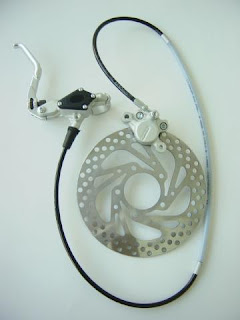
It is actually not very hard to bleed (renew) your own motorcycle brake fluid. This should be done at least every 2 years. Or when the brake fluid turns from clear to a brown to black colour (darker it is, the worse it is).
Brake fluid will eat away at plastic and paint, be sure to cover any paint or plastic that may get splashed with brake fluid. Wipe any spilled fluid with the rag and lots of water.
Step 1: Make sure you have the tools to bleed your brake fluid. The tools you require will vary, but generally this is what you will need:
A. Wrench/Spanner (average 10mm)
B. Brake bleeding kit (rubber fitting, clear hose, small container)
C. Brake fluid overflow container (to put the brake bleeding kit small container in)
D. Rags
E. Brake Fluid (check what type of brake fluid you need for your bike. e.g. DOT 3). Make sure to buy enough brake fluid in the DOT type you require. (500ml should be more than enough).
Step 2: Attach the brake bleeding kit to the brake fluid nipple located on the brake caliper.
Step 3: Loosen the nipple so the fluid is free to flow down the brake bleeding kit tube and into the small container
Step 4: Remove the master cylinder cap (top) so you can monitor and refill more brake fluid into the master cylinder as you bleed the brakes.
Step 5. Pump the brake lever so the old/new brake fluid is forced through the tube into the brake bleeding kit fluid container
Step 6: Keep the volume of the master cylinder constant (near full) as to not have it empty. Keep pumping on the brake lever until the fluid coming out is clear (rather than the old brown/black colour).
Step 7: Once all the tiny air bubbles are gone hold pressure on the brake level and re-tighten the brake fluid nipple to close it off.
Step 8: Replace the master cylinder top cover.
Step 9: Remove the brake bleeding kit from the cliper and use the rag with water to clean up any spillage.
» Read More...


 Posts
Posts


